Why localization strategies fail: The Infinite Loop of the “Last Minute” Fix
4/7/20263 min read
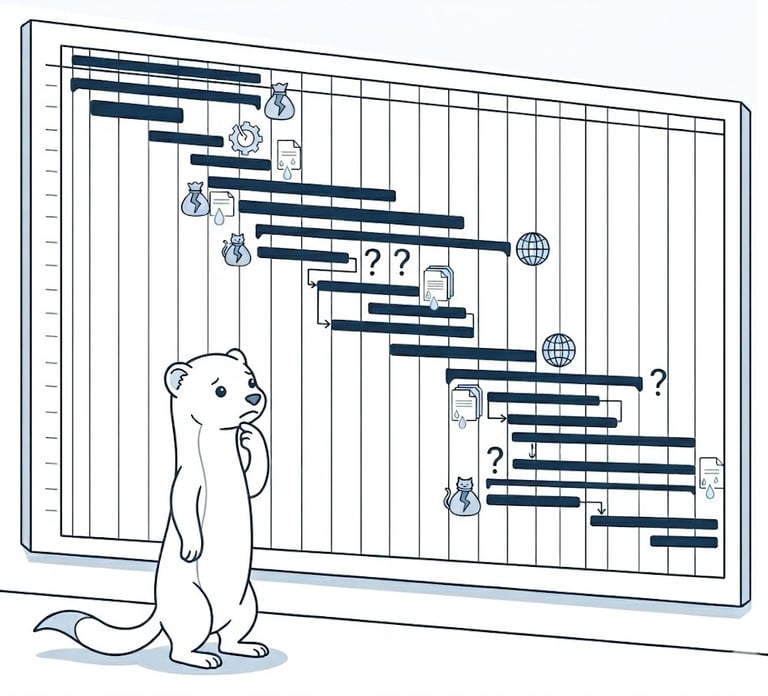
We’ve all seen the LinkedIn posts about “localization best practices”. They talk about automation, AI, and seamless workflows. But for many companies, once you look beyond board presentations and client-oriented offers, the daily reality looks less like a sleek digital highway and more like a firefighting exercise.
At Lumikko, we didn’t set out just to “offer localization services.
We started because we saw the same frustrating patterns repeating over 20 years, regardless of the company’s size or industry. If you feel like your localization process is a cycle of “good enough, but never perfect” quality, unexplained costs, and complicated processes that no-one fully understands, you aren’t alone.
If you want to understand more about the reasons most localization strategies fail, and why it’s so hard to break the cycle, take a look below and see if any of these feel familiar.
The “Final Step” fallacy
By far one of the most common reasons strategies fail is that localization is treated as a tack-on task rather than a core product requirement. As it tends to be pushed to the very end of the project lifecycle, it inherits every delay and budget overrun that happens upstream.
By the time the content reaches the localization team:
The budget is already spent.
The deadline is yesterday.
The source content is already being updated for the next version.
The hard truth: You aren’t “strategizing”, you’re just surviving the launch.
The "Good Enough Quality" trap
Strategies often fail because "good enough" becomes the permanent standard, and not as a consciously made decision, but rather as a coping mechanismEveryone involved can see the cracks: the lists of fixes marked "to be done later", but never actually implemented, reviews that turn into total rewrites, or lack of budget that allows only the lightest of MTPEs instead of in-depth editing. Instead of being solved, they create a system where quality is compromised and uncertain.
Every once in a while someone decides to clean it all up.We’ve seen companies add more review layers to fix bad translations, only to realize those reviewers are just undoing each other's work or fixing one thing while breaking another. This is also usually the point where the process becomes impossible to explain clearly. And when a process is hard to describe without handwaving or a slide deck that looks like a bowl of spaghetti, you have a structural problem.
The hard truth: You cannot "inspect" quality into a product. If the process allows defects to enter upstream, no amount of downstream review will fix it and save your brand voice.
The scalability wall
The most frustrating part of a broken localization setup is that it usually works. It’s painful, it’s unpredictable, it’s expensive, and it makes the team tired, but the localized product eventually gets out the door.
Until it needs to scale.
A "brute force" strategy—relying on heroic individual efforts and last-minute fixes—works for two languages. It might even work for five. But when you need to scale to twenty markets, triple your content volume, or add a new project with completely different requirements, the "handwaving" processes collapse. This is where margins disappear, delivery times explode, and team burnout becomes a retention issue.
The hard truth: If it only works because people are fixing it as they go, it doesn’t work. Systems scale. Effort doesn’t.
Fixing the symptom, not the root
When issues such as missed deadlines, inconsistent quality, or rising costs appear, the response is often to adjust what’s visible: add another review step, switch vendors, introduce a new tool, fill in a new tracker. These actions create movement, but not always resolution.
The challenge isn’t fixing everything either. If you try to overhaul your entire tech stack, your vendor list, and your internal workflows at once, your operations will stop reflecting your strategy and the control will be lost
Sometimes the face-value issues have roots elsewhere and require analysing the content and context creation, project management, or communication.The secret is knowing where to look first.
The hard truth: You can’t fix systemic problems with local fixes.
Moving beyond the patterns
Not every company needs to be a localization expert, but every global company needs a setup that doesn't actively work against them.
At Lumikko, we’ve spent two decades identifying these repeatable patterns, identifying their root causes, and testing different solutions. We know that real strategy isn't about finding a faster way to do the wrong things, but about restructuring the workflow so that localization is a driver of growth, not a bottleneck for delivery.
Is your localization process working, or is it just surviving? Let's find out what needs fixing first.
Contact
Reach out for tailored localization solutions
info@lumikko.io
© 2026. All rights reserved.