The hidden cost of MTPE: why your savings are moving downstream
4/24/20263 min read
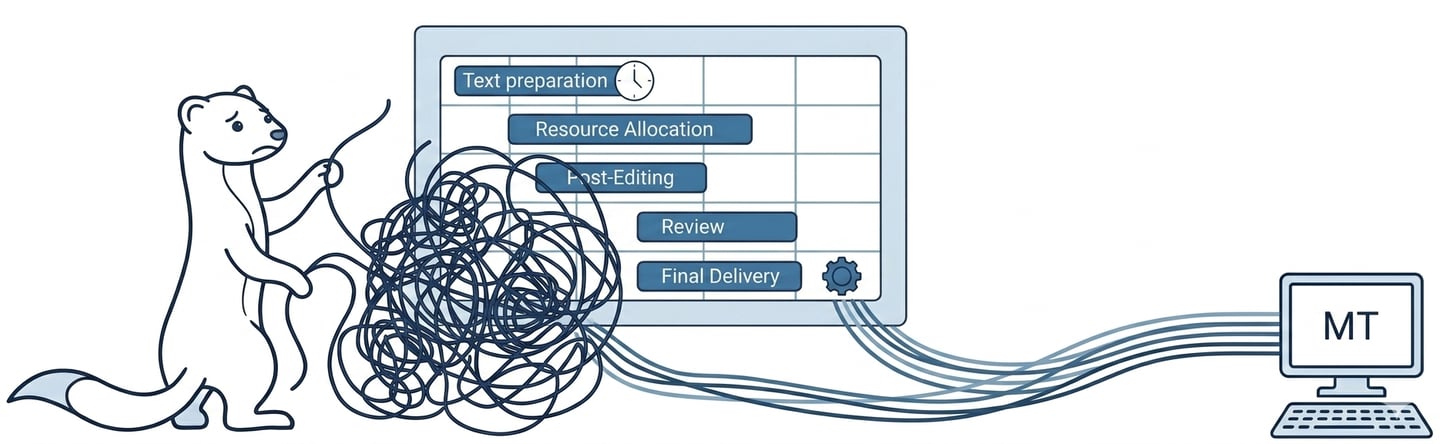
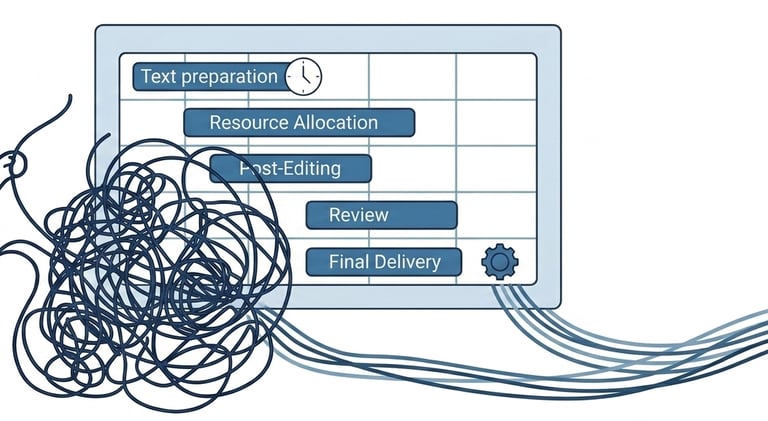
On paper, Machine Translation Post-Editing (MTPE) often looks like a miracle. The math is simple: faster output plus a lower cost-per-word equals a dependent, economical, and scalable localization machine. But in the world of global content, the spreadsheet often shows only part of the truth, if it doesn’t outward lie.
At Lumikko, we’ve seen on multiple occasions that MTPE doesn’t actually reduce the effort required to produce high-quality content, but redistributes that effort, often moving it to the most expensive and time-sensitive parts of your pipeline.
If you’ve noticed that your MTPE projects are still hitting bottlenecks, are weirdly time-consuming, or produce small margins, here is where the hidden costs are likely hiding.
The Displacement of Effort
The biggest myth of MTPE is that the most difficult part of work "disappears" because the machine did the heavy lifting. In reality, without structure, the work just moves downstream.
When a raw machine translation is poor or lacks context, the linguists are not just "editing"—they are performing a forensic investigation. They have to decipher the intent of the source, check additional context such as the speaker's gender or age, figure out why the machine used a specific term and whether it is the glossary item, and then rebuild the sentence, often from scratch.
The hidden cost: You saved time and money on the initial translation, but you’re now paying for a frustrated expert to do twice the cognitive labor during the "edit" phase.
The "Inconsistency Tax"
Machine Translation is notoriously inconsistent. It might translate a UI button correctly on page one and use a completely different synonym on page two.
Without defined assets (like integrated Terminology Bases and Translation Memories), your post-editors are left to rely on their individual judgment. When you have five editors across five languages all making subjective "fixes," your brand voice begins to fracture.
The hidden cost: You eventually have to pay for a "Global Brand Review" or a secondary QA pass just to undo the inconsistencies that the MTPE process created in the first place.
The Quality Seesaw: Speed vs. Standards
Without clear quality thresholds, MTPE becomes a game of "how much can we get away with?"
When the localization team’s goal is simply to "make it readable," but the marketing team expects "on-brand and persuasive," the linguist is caught in the middle. This lack of definition most often leads to repeated edits and changing the same terms over and over in each batch of the text. This is the shortest way to unpredictable timelines and costs, as one can never estimate ahead how much work a given text needs and how many edits might be needed.
The hidden cost: You can never prioritize all three aspects of the infamous service triangle; if you choose fast and cheap, the quality will suffer.
The Fatigue Factor
In an AI-crazy world, we don’t talk enough about the human cost. High-volume, low-context MTPE is exhausting for linguists. When your best language talent is relegated to "fixing the machine output" rather than "crafting the message," engagement drops. This leads to higher turnover in your vendor pool, which means you’re constantly onboarding new people who don’t understand your product—further driving up costs and compromising the quality of your message..
The hidden cost: New tools appear in the market almost every day: you can always choose the one that fits your needs and exchange it to another one if needed. Training people who bring actual engagement and motivation to the whole process is much more complex.
How to make MTPE actually work
MTPE isn't the enemy; unstructured MTPE is. To stop the redistribution of costs, you need a system that supports the technology:
Integrated assets: Your MT engine must be trained or integrated with your specific glossaries and style guides.
Defined quality thresholds: You must be able to categorize content. Is this a "low-visibility" help article where "understandable" is enough? Or is it a high-stakes landing page?
Fast and dependable quality checking process: Good news – it can be automated! This will help you understand what is happening to your content and rise the alarm ahead, if needed.
Feedback loops: If an editor fixes a recurring MT error, that fix needs to be fed back into the system so it doesn't happen again tomorrow.
The Lumikko Take
Efficiency at the input level is meaningless if it creates chaos at the output. If your "cost-saving" MTPE strategy is resulting in last-minute rewrites and unexplained delays, it’s time to stop looking at the cost-per-word and start looking at the cost of the entire system.
The goal isn't just to work faster—it's to work in a way that doesn't require fixing later.
Contact
Reach out for tailored localization solutions
info@lumikko.io
© 2026. All rights reserved.