CPUQ: The cost nobody measures in localization
5/26/20263 min read


Most localization cost discussions revolve around one metric: price per word. It’s the standard way to compare vendors, negotiate budgets, and evaluate spending internally because it’s simple, familiar, and easy to report. The problem is that price per word only measures the visible part of localization costs. It tells you what you paid for the translation itself, but says almost nothing about what happens after that content enters your workflow.
That missing part is usually where the real cost appears.
Two translations can have exactly the same price per word and produce completely different outcomes once they move through review, QA, legal checks, or product validation. One delivery moves through the process quickly and gets approved with minimal effort. The other generates clarification requests, terminology corrections, stakeholder comments, repeated review cycles, and manual fixes that slowly consume time across multiple teams. On paper, both projects cost the same. Operationally, one is far more expensive than the other.
This is the idea behind CPUQ: Cost Per Unit of Quality.
Instead of focusing only on what a translation costs, CPUQ looks at how efficiently that cost translates into usable, reliable, and market-ready content. It connects spending directly to delivered quality and, more importantly, to the amount of friction created after delivery. That distinction matters because localization costs rarely stop at the vendor invoice. They continue accumulating internally through delays, corrections, additional reviews, and the quiet amount of manual intervention teams perform simply to keep projects moving.
Most companies recognize these situations immediately because they happen all the time. Marketing teams adjust copy because the tone feels slightly off. Product managers fix terminology manually before release because sending files back would take too long. Regional teams rewrite headlines to better match market expectations. Legal or compliance teams reopen content that technically passed QA but still creates uncertainty. None of these actions usually appear in localization reporting, but they still consume time, resources, and attention across the organization.
This is also why lower-cost localization is not always cheaper in practice. A low vendor rate only creates savings if the output moves cleanly through the rest of the process. If every delivery requires additional corrections, repeated explanations, or extra QA, then the organization is simply paying for those quality gaps elsewhere. The cost doesn’t disappear; it becomes distributed across different teams and workflows, which makes it harder to measure and even easier to normalize over time.
CPUQ helps expose that hidden operational cost.
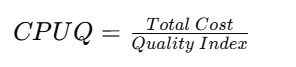
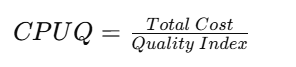
At its simplest level, the calculation looks like this:
The quality index itself can come from different frameworks such as MQM, COMET, BLEU, LISA, edit distance, or internal evaluation systems. The exact scoring model matters less than consistency over time. CPUQ is most useful as a trend indicator because it reveals whether localization efficiency is improving or quietly deteriorating underneath the surface.
If costs remain stable while quality improves, CPUQ becomes more efficient. If costs rise while delivered quality remains flat—or if internal teams spend increasing amounts of time correcting output after delivery—CPUQ starts increasing. That increase is often one of the earliest signs that a localization process is becoming harder to scale.
What makes CPUQ particularly valuable is that it identifies operational friction before larger organizational problems appear. Most localization systems do not fail dramatically. Instead, they slowly become heavier to maintain. Review cycles grow longer, stakeholder involvement increases, and teams begin building small workarounds into their daily processes simply to compensate for inconsistent output. Over time, those workarounds become normalized, and the organization adapts to the inefficiency instead of addressing it directly.
At that point, the issue is no longer translation quality alone. Localization has started affecting delivery speed, internal workload, release predictability, and scalability across the business. That is why CPUQ changes the conversation so significantly. Instead of asking which vendor offers the lowest price per word, companies begin asking which setup produces the least friction while still delivering the quality level the business actually needs.
Those are very different questions, and they usually lead to very different decisions.
Contact
Reach out for tailored localization solutions
info@lumikko.io
© 2026. All rights reserved.